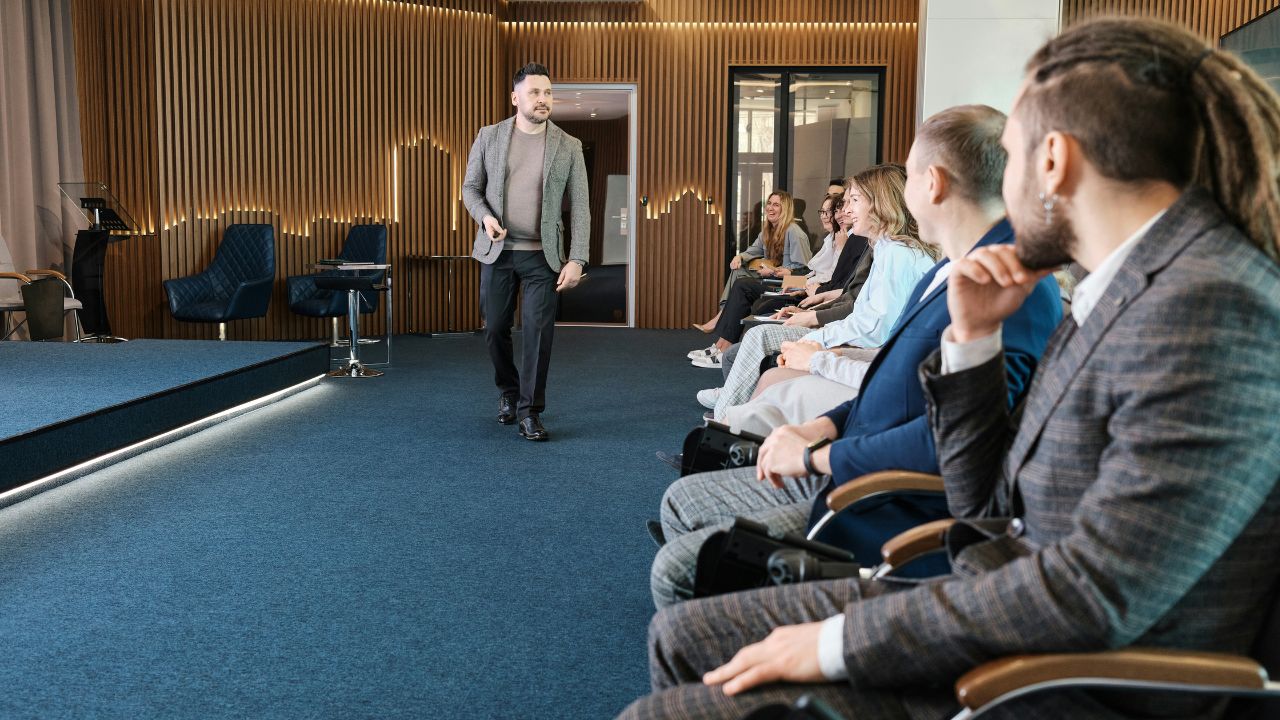
Calm-room polish is not the test. The boardroom reads how you think, communicate, and lead when the stakes peak, and that is a trainable discipline.
Executive presence under pressure is the capacity to keep thinking clearly, communicating persuasively, and leading decisively when the stakes in the room rise. Pressure reveals it; nobody performs it. The boardroom does not grade the polish you arrive with. It grades what happens to you when the board challenges the numbers, the clock shrinks, and every eye moves from the slides to you. Most executives prepare for polish; the room is testing something else. The test itself has three parts, and every one of them is trainable.
What does the boardroom actually test under pressure?
The boardroom tests three things under pressure: whether your thinking stays clear, whether your argument survives challenge, and whether the room still follows you when certainty drops. None of them appears on the agenda. All of them are being scored from the moment the first hard question lands.
Notice what is missing from that list. Delivery technique. Slide quality. Eloquence. Those matter in the way a clean pitch matters in sport: necessary, and nowhere near sufficient. The foundations of executive presence sit on their own page; what follows is about the specific moment pressure arrives and starts asking its own questions.
Because that is how a board operates under pressure: it probes. It interrupts the sequence you rehearsed. It asks the question behind the question. Presenting well gets you through the prepared minutes. The real test begins when the presentation stops being yours.
The pressure test: five questions to ask before your next high-stakes room
- What is the one decision this room must leave with?
- Which question do you least want asked, and what is your answer to it?
- What are your first 10 seconds after a hard challenge?
- What will you cut if your 30 minutes becomes 10?
- What does recovery look like if you lose the room mid-meeting?
Answer all five before you walk in and pressure becomes a variable you have planned for. Leave them unanswered and the room will ask them for you.
Why do polished presenters lose the room when stakes rise?
Polished presenters lose the room because polish optimises the script, and pressure attacks the person. Rehearsal and readiness are not the same discipline. A rehearsed deck answers the questions you chose; a live boardroom asks the ones you did not.
When stakes rise, scrutiny migrates. In a calm room, attention sits on the material. In a high-stakes one, attention sits on the leader: on hesitation, on recovery speed, on whether the voice carrying the recommendation still believes it under fire. An executive can deliver a flawless 20 minutes and lose the meeting in the 90 seconds of challenge that follow. The 20 minutes had rehearsal behind them; the 90 seconds had none.
.png)
That migration is why calm-room competence and pressure-room authority are different capacities. The room only ever remembers the second. It is also why preparation built entirely around the script leaves the actual test unprepared for.
What are the three capacities pressure reveals?
Pressure reveals how a leader thinks, communicates, and leads. Usually in that order, and usually within minutes.
Thinking shows first. Pressure compresses time and strips out certainty; the room watches whether your decision clarity survives that compression. Leaders who hold form keep sight of the one decision that matters and let go of the rest. Leaders who lose form defend every slide equally, a reliable signal that clarity has gone.
Communication shows next. Delivery matters less than durability: does the argument keep its shape under interruption? Can you restate the case in one sentence when asked to? Can you absorb a hostile reframing and return to your structure without reciting it?
Leadership shows last, and the room remembers it longest. Under pressure, a room looks for somewhere steady to stand. The leader who stays composed, genuinely composed rather than performing calm, becomes that place, and momentum follows them. The leader who wobbles hands the meeting to whoever steadies first.
None of the three is charisma, and none is a fixed trait, which is what makes the next question answerable.
Can executive presence under pressure be trained?
Yes. Senior leaders assess and develop executive presence under pressure the way they would any performance discipline: through deliberate practice against real scrutiny, with the people who experience it keeping score. As Moustafa Hamwi defines it: "Executive presence is a learnable performance discipline — not a personality trait — for how leaders think, communicate, and lead under pressure."
The trait myth persists because pressure moments feel innate: some leaders seem born steady. Watch closely and the steadiness decomposes into behaviours. How they enter, how they buy thinking time, how they take a hit and reset. Behaviours are rehearsable. A leader can rehearse them, assess them honestly, and develop them before a high-stakes presentation rather than gamble on them during one.
The consequence for senior leaders is direct: if presence under pressure is trainable, then arriving untrained is a choice, and boards increasingly read it as one.
How do senior leaders prepare for the moments that matter?
Senior leaders prepare for high-stakes moments by rehearsing the challenge, not the script. The script is the smallest part of the test. Three practices carry most of the weight:
Pre-decide the decision. Before the room, fix the one outcome the meeting must produce, your fallback position, and the point at which you stop conceding. Clarity built in advance survives compression; clarity improvised under fire rarely does.
Rehearse the hostile question aloud. Not in your head. Aloud, against a counterparty whose job is to unsettle you. The first time you hear the question you fear, it must not be in the boardroom. This is where you build readiness, and where you assess your presence honestly before the stakes are real.
Build a recovery routine. Every leader gets hit; the test is the reset. A fixed sequence of pause, acknowledge, reframe, continue turns recovery from a hope into a habit. Rooms forgive the hit. They remember the recovery.
The pattern across all three is the same: preparation aimed at pressure, not polish. Rehearsal makes you smooth. Readiness makes you steady. The boardroom pays for steady.
The room was never grading your slides. It grades what pressure reveals, and what it reveals is trainable. Prepare for the test, not the performance. The full capability map, spanning composure, communications, and leading through disruption, lives at Master Executive Presence.
.png)
Related reading: executive composure, the thinking layer under pressure.
FAQ
How do executives maintain executive presence under pressure?
Executives maintain executive presence under pressure by treating it as a prepared discipline rather than an in-the-moment performance. The core practices: decide the meeting's one essential outcome in advance, rehearse the hardest questions aloud against a real counterparty, and run a fixed recovery routine of pause, acknowledge, reframe, continue. Executives who prepare this way stay clear and credible precisely when scrutiny peaks.
What counts as a high-pressure leadership moment?
A high-pressure leadership moment is any room where the outcome is uncertain, the scrutiny is personal, and time is short. Think of a board challenge, an investor question, a crisis briefing, a restructure announcement. The common factor is that attention shifts from the material to the leader.
Is executive presence different under pressure than day to day?
The discipline is the same; the tolerance is not. Day to day, small lapses in clarity or composure pass unnoticed. Under pressure, the room reads every hesitation as information, which is why leaders assess and develop presence against high-stakes conditions, not calm ones.
Can composure be learned?
Yes. Composure is a learnable capability, not a temperament. It is the thinking layer of executive presence: staying clear, deciding well, and recovering fast when pressure peaks. The executive composure page sets out how leaders build that capability.
What is executive presence?
Executive presence is the umbrella discipline that sits above executive composure, executive communications, and leading through disruption. The definition, its components, and how leaders develop it are set out at what executive presence is.
How long does it take to build executive presence under pressure?
Long enough to rehearse, not long enough to delay. Progress comes from deliberate practice against real scrutiny: question-handling, recovery, decision clarity. It compounds across real rooms rather than course hours. The honest answer: faster than most leaders expect, provided the work targets pressure rather than polish.